Precise Impactor
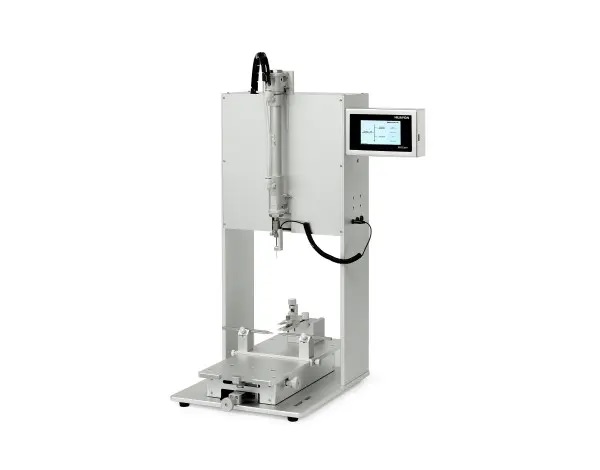
The Precision impactor is designed to induce traumatic brain injury (TBI) through controlled cortical impact modeling in small and medium sized animals such as mouse, rat, rabbits etc. The advanced equipment uses pneumatic electric control to accurately regulate the strike speed, depth, dwell time and force by the tip, and allows researchers to achieve precise strikes with excellent accuracy and repeatability. The control method adopts touch screen control without software to install. It can be turned on with one click and operated step by step. The zero calibration method adopts a sensor contact mechanism to automatically detect and identify the zero interface, which is sensitive and efficient, and then reducing the error of judgment. Stereotaxic Impactor also allows for customization of the tip size, geometry, and position to accommodate different species. Together, these features enable researchers to address multiple histopathological and functional questions related to brain injury, making it an indispensable tool in neurotrauma research.
HARDWARE:
- Using a cylinder to control the striking speed, a servo motor to control the striking depth, an electromagnetic valve to control the cylinder start, and an electronic control valve to control the intake air volume, thus achieving precise striking by changing the cylinder speed.
- 4.3-inch touch screen control with an IPS full wide-angle screen, featuring a friendly, concise, and beautiful UI operation interface, step-by-step operation, and multiple confirmation methods during the operation process to reduce misoperation.
- Using a capacitive touch method for contact zeroing to reduce errors.
- Strike speed calibration, with the set strike speed and actual strike speed displayed at the end of the test.
- The brain and spinal cord fixation devices for different animals can be flexibly switched, with flexible horizontal X-Y axis position adjustment. The head adaptor features fine-tuning functions in the front-back and left-right directions. Brain and spinal cord adaptors, along with anesthesia masks, can be optionally installed for use with gas anesthesia machines.
SOFTWARE:
- Equipped with startup zeroing, speed calibration, and startup operation prompt functions.
- Experimental parameter settings with a memory function, automatically retaining the last set striking parameters.
- The striking mode offers two options: Speed (SPEED) and Pressure (PRESSURE). Speed mode performs the strike by setting the movement speed of the cylinder, including the telescopic rod, while pressure mode performs the strike by setting the air pressure required when the cylinder telescopic rod extends.
- The speed setting range is 0.5–5.6 m/s, with an accuracy of ±0.1 m/s when the speed is below 3 m/s. The pressure setting range is 0.03–0.35 MPa, with an accuracy of ±0.01 MPa.
- The strike depth setting range is 0–5 mm, with an accuracy of ±1 μm.
- The dwell time setting range is 0–5 s, with an accuracy of ±0.01 s.
- Zeroing calibration function: When the striking head comes into contact with the experimental object, a buzzer provides an audible prompt to confirm contact.
- Two methods are available for adjusting the striking rod position and setting the striking depth: quick adjustment, which allows the striking rod to move rapidly, and step adjustment, which allows the striking rod to move up or down in 10 μm increments.
- At the end of the experiment, experimental data is displayed, including a comparison between the set and actual values for impact speed/pressure, impact depth, and dwell time.
- Experimental log function: View and replay nearly 50 sets of experimental data, including impact speed/pressure, impact depth, dwell time, and experimental time.